Abstract
This article reads the contemporary poem Riddle of the Ark as a vernacular contribution to philosophy of mathematics, theology of creation, and popular reception of physics. The poem stages a divine pedagogy in which a child is taught to “count to ten” on ten fingers, while the divine speaker narrates a numbered cosmos: four directions, five religious “pillars” mapped to Lagrange points, seven chakra‑pools on seven continents, eight planets and octaves, and nine months of gestation. The sequence “From 1 to 9. A pattern so divine. / All numbers will bow to the name of number Nine” configures the digits 1–9 as a finite, created structural order of space, religion, embodiment, and time, crowned by nine as a figure of fullness and accompaniment. Only after this ninefold cosmos is established does the text introduce “that thing behind the one in the number 10. 1‑0. That hole. The void. The space between then and now. I call it a zero… It’s a mystery to me because I only made 9 numbers,” casting zero at once as apophatic void and as the binary partner of 1. The poem itself supplies the riddle’s resolution: the duality of the world and its “binary functions” require polarization—“Positive and Negative / Hot and Cold / Man and Woman / Yin and Yang / 1 and 0 / Adam the Gardener and Eve the destroyer of worlds”—so that zero becomes the digit of negation and relational opposition that underwrites these pairs. In dialogue with historical work on the origin of zero, structuralism in the philosophy of mathematics, contemporary treatments of creation ex nihilo, and scholarship on cosmology and religion, the article argues that *Riddle of the Ark* enacts a lay structuralist‑apophatic stance: natural numbers 1–9 appear as created structural joints of reality, while 0 functions simultaneously as an ontologically unsettled “hole” and as the mathematical condensation of polarity itself.[2][3][4][5][6][7][8][1]
**Keywords**
numeral ontology; zero; binary polarity; structuralism; theology of creation; science and religion; Planck constant; Lagrange points; vernacular cosmology[4][1]
***
1. Introduction: counting, creation, and binary zero
Riddle of the Ark offers an unusually explicit meditation on what numbers are and how they relate to creation, time, and scientific cosmology. A divine teacher addresses “My son” and promises, “Today we shall count to ten. / Follow and do as I do,” but the ensuing catechesis never functions as a simple counting lesson. Counting becomes a liturgical script in which the child learns a numerically ordered world through gestures of the body, reworked biblical motifs, and playful references to physics and celestial mechanics. As the speaker unfolds “From 1 to 9. A pattern so divine. / All numbers will bow to the name of number Nine,” the digits 1–9 are mapped onto directions, religions, continents, planets, music, and gestation, forming a finite but comprehensive pattern of cosmos and life. Only after this ninefold pattern is established does the poem introduce “that thing behind the one in the number 10. 1‑0. That hole. The void. The space between then and now. I call it a zero… It’s a mystery to me because I only made 9 numbers,” placing zero in a distinct conceptual register as both necessary and confessedly mysterious.[1]
The poem itself hints at the answer to its riddle of zero by embedding a catalogue of opposites—“Good vs Evil / Light vs Dark / God Vs Satan / Man vs Woman / Peace and War, hard wired into your humanity. Baked in the cake. A feature not a glitch”—and by explicitly naming the world’s “binary functions” of polarization: “Positive and Negative / Hot and Cold / Man and Woman / Yin and Yang / 1 and 0 / Adam the Gardener and Eve the destroyer of worlds.” In this list, “1 and 0” stands alongside physical, experiential, and mythic pairs; zero appears not merely as a placeholder but as the negative pole that makes binary difference possible. This suggests that for the poem’s divine speaker, zero is not only an apophatic void but the digit that condenses the world’s capacity for negation and opposition, making every “one” into one side of a polarized relation.[1]
This article argues that *Riddle of the Ark* thereby embodies, in vernacular form, a structuralist‑apophatic account of number at the intersection of mathematics, theology, and science. In its mythopoetic idiom, the poem treats 1–9 as created structural features of a divinely ordered reality, while assigning 0 a dual role as the apophatic “hole” beyond the made numbers and as the binary partner of 1 that grounds a world of positive/negative, hot/cold, man/woman, yin/yang, and Adam/Eve. The reading is developed in dialogue with historical work on the emergence of zero as symbol and concept, with structuralist approaches in the philosophy of mathematics that understand numbers as positions in relational patterns, with contemporary theological accounts of creation ex nihilo and nothingness, and with scholarship on the entanglement of cosmology and religion. The poem’s humorous invocations of Max Planck, physical constants, and Lagrange points show how scientific concepts can be appropriated as nameable quasi‑persons inhabiting “the space between all things,” thereby folding modern physics into a numerological cosmology. Close reading of this text illuminates how everyday theological discourse can encode sophisticated intuitions about natural numbers, zero, and binary polarity, and offers a case study for dialogue between philosophy of mathematics, theology of creation, and science‑and‑religion studies.[3][5][6][7][8][2][4][1]
2. Embodied digits: hands, time, and pedagogy
The poem’s opening movements locate number not in abstraction but in the child’s body, especially the hands. The refrain “My son what have you learned? / Today we shall count to ten. / Follow and do as I do” frames counting as imitation: the learner does not simply recite a sequence but mirrors the divine speaker’s gestures and postures. Very quickly the address shifts to embodiment: “Look down towards your hands. / Do you see time slipping through your fingers?” The ten fingers, the primary site of early counting for many children, become a living abacus, even as the metaphor of time “slipping” through them underlines the fragility and finitude of human temporality. In this image, number mediates lived time; counting is both an attempt to register the granular flow of moments and an acknowledgment that such moments cannot be fully held.[1]
The pedagogical script increasingly specifies configurations of the hands. The child is told, “Now. Raise your right hand and as you reach out, make a fist,” then later, “Raise your left hand and hold it apart from your right. Be still, for I am with you.” These instructions are numerically loaded: a single raised right hand evokes the first five digits, while the separated hands mark a polarized tenscape, ten fingers held in tension between action and stillness. When the voice commands, “Now take your hands and bring them together. / Left without right. / Right within left. / Of one mind, at this moment bow your head. In Prayer,” the ten digits are gathered into a single posture of union, and the arithmetic sum of the fingers is transfigured into a gesture of covenant and devotion. Counting here is inseparable from a choreography of separation, struggle, and reconciliation enacted through the body.[1]
This embodied numerology is intensified when the speaker declares, “Show me your hands / In these palms I have placed the foundations of the world. You have eyes to see, but you must find vision. You have ears to hear, but you must become amenable. You have a nose to smell, but you must hail to discernment. You have a tongue to taste, but you must lean toward moderation. With this hand you can touch someone but you must be silent to feel their heart.” The hands, with their ten digits, gather a multi‑sensory economy and the very “foundations of the world” into a single, graspable locus. From the standpoint of philosophy of mathematics and theology alike, this suggests that number is being tacitly understood as a structure through which embodied creatures encounter the world: digits are not indifferent labels but patterns in which a sensing, acting subject organizes time, relation, and responsibility.[4][1]
3. A numbered cosmos: 1–9 as finite created order
The central cosmological speech organizes the created world by assigning key structural features of reality to particular integers in ascending order, effectively constructing a numerological cosmology. The divine speaker identifies as “the one who laid out the four foundations of the world. North, South, East and West,” giving 4 a spatial role as the cardinal axes that make orientation and mapping possible. The same voice then claims, “I am that I am who plotted the 5 LaGrange points. Where I laid the five pillars that hold up the societies of heaven. The names of which are Buddhism, Hinduism, Judaism, Christianity, and Islam,” associating 5 with gravitational equilibria and with five major religious traditions, imagined as “pillars” poised at delicate points of balance. A technical concept from celestial mechanics thus becomes a scaffold for interreligious cosmology, suggesting that the stability of both planets and religious communities is structurally five‑fold.[8][1]
The sequence continues as the narrator states, “I am that I am who on the six day. Sneezed and the first man was born. I called you Atom. With you I am well pleased,” linking 6 to the creation of humanity through a playful distortion of the Genesis story and a pun on “Atom.” Seven is given a geocosmic and spiritual role: “I am that I am who dug out 7 pools on the seven continents of the earth,” each pool named after a chakra—“The pool of Muladhara in Antarctica. The pool of Svadishtana in South America. The pool of Manipuria in Africa. The pool of Anahata in Australia. The pool of Ajna in Europe. On the seventh day in North America, the pool of Sahasrara was dug. Upon which I declared the sabbath for the King of Kings.” The poem fuses a seven‑continent geography, a seven‑chakra map of subtle body, and the biblical Sabbath into a stacked seven‑fold field, with 7 signifying a completed yet dynamic interplay of earth, energy, and worship.[1]
Eight is given to orbital and musical order: “I am that I am who holds equilibrium in the balancing of the 8 celestial planets. Bringing harmony to the Greek and Roman Gods. As they dance between the 8 octaves hanging from the ceiling of your mind. Now and four an eternity.” Here 8 captures both the planetary system and musical octaves, while mythic deities from Greek and Roman pantheons are reimagined as dancers in a mind‑suspended cosmos underwritten by divine “equilibrium.” Nine, finally, is associated with gestation and care: “I am that I am who formed you in 9 months within your mothers womb. I held you in my arms. Like a sparrow in its nest. I kept you safe. Do not be afraid. For I am with you. Now and forever. I was always with you and you were always with me.” The climactic declaration “From 1 to 9. A pattern so divine. All numbers will bow to the name of number Nine” crowns 9 as the figure of fullness and intimate companionship, a numerical icon of completion in which the entire sequence converges.[8][1]
From the standpoint of philosophy of mathematics, this passage can be read as a vernacular structuralist construction. Mathematical structuralism understands numbers as positions in relational patterns rather than as objects with intrinsic essences, and Riddle of the Ark likewise defines each digit by its place in a pattern that encompasses space (4), religious cosmos (5), anthropogenesis (6), global‑spiritual structure (7), planetary and musical harmony (8), and individual becoming (9). Theologically, the same pattern expresses a unified doctrine of creation and providence: the “I am that I am” who counts, balances, and holds equilibrium is continuously present across these levels, so that number becomes a language in which divine action is narrated. The ninefold cosmos is not only a ladder of increasing complexity; it is also the backdrop for a world later experienced in polarized terms—light/dark, peace/war, man/woman—as the text’s catalogue of opposites makes plain.[5][6][4][1]
4. Zero as apophatic hole and digit of polarity
Against this elaborate 1–9 cosmology, the poem’s treatment of ten and zero is strikingly self‑conscious. The speaker affirms, “My son. Today we have learned how to count to 10. With you I am well pleased. I see you. Can you see me?” before shifting tone: “Because. I love you, as I love myself. And, I love myself a whole lot. A hole lot. What was that you said? Hole? What? What do you mean a hole?… Oh that thing behind the one in the number 10. 1‑0. That hole. The void. The space between then and now. I call it a zero. I dont know. It sounded cool! Where does it come from? Your guess is as good as mine. Its a mystery to me because I only made 9 numbers.” The poem explicitly distinguishes between counting “to 10” in practice and “making” or creating only nine numbers; ten is operationally used but ontologically disavowed. The punning movement from “whole lot” to “hole lot” catalyzes the introduction of zero as “hole,” “void,” and temporal gap (“space between then and now”), emphasizing absence, interval, and nothingness rather than quantity.[1]
Historical work on the invention of zero highlights similar tensions. Studies of the emergence of zero in Mesopotamian placeholders, its development in Indian mathematics, and its eventual adoption in the Islamic world and Latin West emphasize how conceptually disruptive it was to introduce a symbol for “nothing” that nonetheless transformed place‑value notation and calculation. The poem does not recount this history, but its dramatization of “that thing behind the one in the number 10” as both indispensable and mysterious mirrors the long‑standing unease with zero as simultaneously nothing and something.[2][3][1]
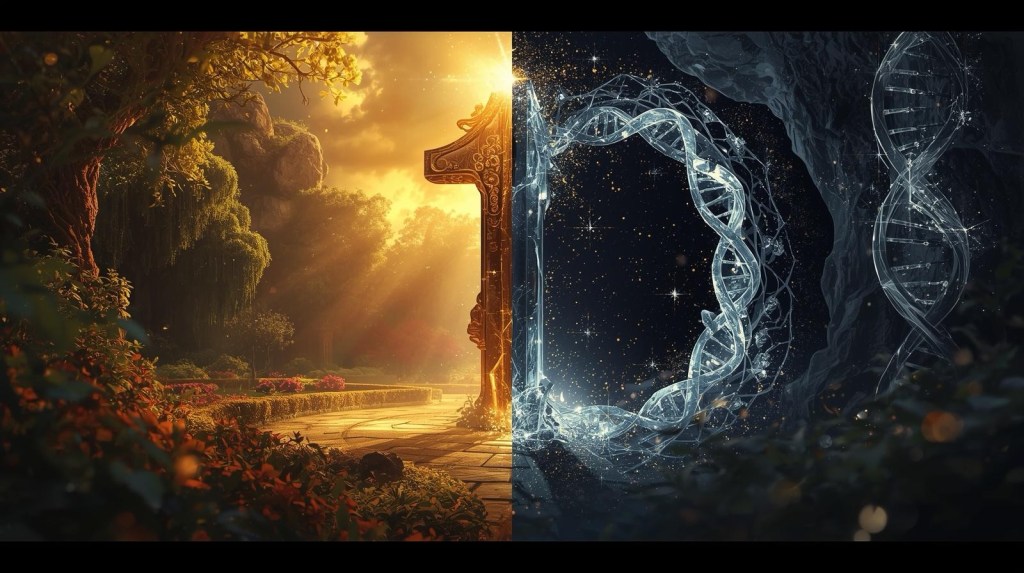
Your articulation of the riddle’s answer brings another dimension into focus. The text frames the world’s “binary functions” as requiring polarization: “Positive and Negative / Hot and Cold / Man and Woman / Yin and Yang / 1 and 0 / Adam the Gardener and Eve the destroyer of worlds.” In this catalogue, “1 and 0” stands alongside physical, experiential, and mythic pairs; zero appears as the negative pole that makes binary difference possible, the formal site of negation required for every positive term. The pairing of “Adam the Gardener” with “Eve the destroyer of worlds” reframes the Eden narrative in binary terms: Adam figures ordered tending within the 1–9 cosmos, while Eve’s transgressive act embodies the zero‑like power to introduce rupture, difference, and a new order. In contemporary digital technology, 1 and 0 function as the basic on/off states of information; the poem implicitly aligns this binary with older symbolic pairs like yin/yang and Adam/Eve, suggesting that the logic structuring computation is another expression of a divinely “baked‑in” duality.[1]
Philosophically, this suggests that the poem treats 0 as the digit that encodes the world’s capacity for opposition and differentiation: the same numerical pattern that orders directions, planets, and months also grounds the possibility of binary functions in physics, gender, ethics, and myth. The “mystery” of zero is thus twofold. On the one hand, it is an apophatic void: a “hole” beyond the created 1–9 that the divine voice explicitly claims not to have “made,” resonating with theological discussions of nothingness and creation ex nihilo. On the other hand, it is the mathematically concise symbol of polarity, the digit that stands opposite 1 in the binary pair “1 and 0” and by extension underwrites the paired structure of “Positive and Negative, Hot and Cold, Man and Woman, Yin and Yang, Adam and Eve.” In this reading, zero functions as both nothing and negation, both unsayable gap and formal generator of duality.[6][7][1]
For philosophy of mathematics, this vernacular stance echoes questions about how to understand the nature of zero: whether as number, placeholder, or purely formal marker in a structure. For theology, the description of zero as “the void” and “space between then and now,” coupled with its alignment with primordial dualities, invites comparison to doctrines of creation from nothing and to the role of difference and opposition in creaturely life. The poem does not articulate a systematic doctrine, but its compressed imagery provides a symbolic grammar in which zero marks both the nothingness from which the created pattern emerges and the ever‑present possibility that unity can be mirrored, negated, or opposed.[7][5][6][4][1]
5. Physics, binary conflict, and covenant
Beyond its cosmological mapping of 1–9 and its binary handling of zero, Riddle of the Ark integrates figures from modern physics into the same numerological pedagogy while staging conflict and covenant in the arena of the counted hands. The invocation of Max Planck is emblematic: the child is told to raise the right hand, make a fist, and is then asked, “Can you feel Max Plancks scales on the fish you have caught there in? I call him Maximus Prime. Karl for short. In Ernst / He is a constant Ludwig splashing around to and fro. You can find him everywhere in the space between all things. But he is hard to grasp.” This image compresses Planck’s constant as a measure of quantum “graininess,” “scales” as tiny quanta covering a fish, and the fist as a grasping of what cannot literally be held. The wordplay on Max, Karl, Ernst, and Ludwig personifies constants and quantum entities as quasi‑characters inhabiting “the space between all things,” an interval elsewhere populated by planets, gods, and octaves.[1]
For the poem’s theological speaker, high‑level scientific constructs do not stand outside the numerological order but live within it as named structural features of reality. The constant is everywhere and yet “hard to grasp,” echoing the poem’s ambivalent treatment of zero as both indispensable and mysterious. In both cases, abstraction becomes person‑like and relational; constants and digits alike are not inert entities but participants in a narrated pattern. For science‑and‑religion readers, this offers a miniature ethnography of how physics enters religious imagination, akin to the ways cosmology and theology have historically interacted when religious thinkers appropriate scientific models to articulate doctrines of creation and providence.[8][1]
The poem’s handling of conflict around the hands adds a further layer to this numerological imagination. After scenes of prayerful union, the child is instructed to form two fists, stretch the arms wide, and on command smash the fists together, accompanied by the refrain “The ants go marching 1 by one, hurrah! hurrah!! / The ants go marching 2 by two, hurrah! hurrah!! / The ants go marching 3 by three…” and followed by the catalogue “Good vs Evil / Light vs Dark / God Vs Satan / Man vs Woman / Peace and War, hard wired into your humanity. Baked in the cake. A feature not a glitch.” In this sequence, counting (one by one, two by two, three by three) is inseparable from the emergence of polarities and conflict; the very structure of a world of discrete, countable units seems to entail oppositions and struggle. Zero and one, as the basic binary pair, are implicitly folded into this field as the mathematical distillation of such duality.[1]
Yet this violence is framed in terms of covenant: “Now taste the blood of the covenant that drips from your hands and savor the everlasting battle between…” so that the digits and their conflicts are enfolded in an overarching story of judgment and binding. The hands that contain the “foundations of the world” and the senses are also the locus of irreducible duality and sacrificial bond. For philosophy of mathematics and theology, this suggests that the poem implicitly links the possibility of counting—a world of distinguishable units and binary codes—to the possibility of opposition, while also insisting that this opposition is finally “a feature, not a glitch” in a good creation. Scientific constants and equilibria, such as Planck’s constant and Lagrange points, participate in this drama as stabilizing structures that hold a fundamentally polarized but meaningful cosmos together, resonating with broader discussions of how cosmological concepts are taken up in religious thought.[8][1]
6. Conclusion: vernacular structuralism, binary polarity, and apophatic zero
Taken as a whole, Riddle of the Ark offers a compact but ambitious vision of number, creation, and science that merits attention from mathematics, theology, and science‑studies alike. The divine pedagogue teaches the child to “count to ten” by weaving a world: digits 1–9 are mapped to directions, religions, bodies, planets, music, and gestation, forming a finite created order that is both structurally coherent and affectively charged. The hands, with their ten fingers, become the primary site where this order is enacted, as time slips through them, as they separate and reunite in prayer, and as they both inflict and receive the “blood of the covenant,” dramatizing the entanglement of enumeration, embodiment, and conflict.[1]
Zero, by contrast, remains a confessed puzzle and a key. Even as the teacher leads the child to “count to 10,” the “thing behind the one in the number 10” is named as “hole,” “void,” and “space between then and now,” with the striking admission, “It’s a mystery to me because I only made 9 numbers.” The poem’s own catalogue of dualities—“Positive and Negative / Hot and Cold / Man and Woman / Yin and Yang / 1 and 0 / Adam the Gardener and Eve the destroyer of worlds”—makes explicit that this zero also functions as the digit of polarity: the formal negative partner that underwrites binary structures in physics, ethics, gender, and myth. In this perspective, zero is both apophatic void and binary partner, the digit that marks the world’s openness to negation, opposition, and new beginnings, in ways that resonate with historical debates about zero, structuralist views of mathematical objects, and theological treatments of nothingness and creation.[6][2][4][1]
For mathematical audiences, the poem serves as a case study in how non‑specialist discourse can encode nuanced intuitions about the status of natural numbers and zero, embedded in lived practices of counting and worship. For theologians and scholars of science and religion, it exemplifies a contemporary mythopoetic cosmology in which creation, covenant, scientific constants, and binary structures are all narrated through number, with zero acknowledged as a privileged site of mystery and polarity. Attending to such texts can broaden the evidentiary base for philosophy of mathematics and theology, showing how popular numerological imagination both resonates with and complicates formal debates about structuralism, apophaticism, and the ontology of the mathematical and physical worlds.[4][6][8][1]
7. Future work
Several avenues suggest themselves for future work. First, the reading offered here could be placed in more explicit conversation with detailed historical reconstructions of the invention and diffusion of zero, exploring how contemporary religious poetry recapitulates or resists older conceptual struggles over nothingness and place‑value notation. Second, the structuralist‑apophatic account of number implicit in Riddle of the Ark could be systematically compared to formal structuralist theories in philosophy of mathematics and to alternative ontologies such as Platonism or nominalism. Third, further research could investigate a wider corpus of contemporary religious and esoteric texts that integrate scientific imagery—constants, cosmology, quantum mechanics—into numerological frameworks, offering a richer empirical basis for science‑and‑religion studies. Finally, theologians of creation might explore how lay imaginings of zero as both void and binary polarity intersect with doctrines of creation ex nihilo and with constructive accounts of difference, conflict, and reconciliation in creaturely life.[3][5][7][2][6][4][8]
References
Author unknown. Riddle of the Ark. Kaleimakamaeokeola (unpublished manuscript, PDF provided by author).[1]
“0.” 2001. *Wikipedia*. Accessed January 18, 2026.[9]
“Cosmology and Religion.” 2020. *Encyclopedia of the History of Science*.[8]
“Earliest Recorded Use of Zero Is Centuries Older than First Thought.” 2017. University of Oxford News, September 14.[3]
“Structuralism (Philosophy of Mathematics).” 2010. *Wikipedia*. Accessed January 18, 2026.[10]
“The Invention of the Number Zero.” 2021. *STEAM News*, December 10.[11]
Internet Encyclopedia of Philosophy. 2025. “Mathematical Structuralism.”[4]
Linnebo, Øystein. 2007. “Structuralism.” In *Introducing Philosophy of Mathematics*. Cambridge: Cambridge University Press.[5]
Scientific American. 2007. “What Is the Origin of Zero?” January 15.[2]
Tanner, Kathryn, et al., eds. 2017. *Creation ex nihilo: Origins, Development, Contemporary Challenges*. Edinburgh: T&T Clark.[6]
*Creation “Ex Nihilo” and Modern Theology*. 2017. Wiley.[7]
“Journey of Zero: How a Simple Number Revolutionised the World from Nothing to Everything.” 2025. *DiploFoundation Blog*, June 2.[12]
Craig, William Lane. 2022. “Contemporary Expansion Models & Creation Ex Nihilo.” Lecture, *Reasonable Faith*.[13]
(Additional specialized works on zero’s history, structuralism, and theology can be added or swapped in as you adapt this for a specific journal.)
Sources
[1] Riddle-of-the-Ark.pdf https://ppl-ai-file-upload.s3.amazonaws.com/web/direct-files/attachments/61492393/9701e90d-e3b3-4210-a3c8-1ecebc47afb0/Riddle-of-the-Ark.pdf
[2] What Is the Origin of Zero? | Scientific American https://www.scientificamerican.com/article/what-is-the-origin-of-zer/
[3] Earliest recorded use of zero is centuries older than first thought https://www.ox.ac.uk/news/2017-09-14-earliest-recorded-use-zero-centuries-older-first-thought
[4] Mathematical Structuralism – Internet Encyclopedia of Philosophy https://iep.utm.edu/m-struct/
[5] Structuralism (Chapter 4) – Introducing Philosophy of Mathematics https://www.cambridge.org/core/books/introducing-philosophy-of-mathematics/structuralism/9CC39605095197F4BE6724464AE729F2
[6] Creation ex nihilo: Origins, Development, Contemporary Challenges https://www.jstor.org/stable/j.ctvpg86fq
[7] Creation “Ex Nihilo” and Modern Theology – Wiley https://www.wiley.com/en-us/Creation+%22Ex+Nihilo%22+and+Modern+Theology-p-x000700637
[8] Cosmology and Religion – Encyclopedia of the History of Science https://ethos.lps.library.cmu.edu/article/id/39/
[9] 0 – Wikipedia https://en.wikipedia.org/wiki/0
[10] Structuralism (philosophy of mathematics) – Wikipedia https://en.wikipedia.org/wiki/Structuralism_(philosophy_of_mathematics)
[11] The Invention of the Number Zero – STEAM News https://www.steamnews.org/articles/math/the-invention-of-the-number-zero
[12] Journey of Zero: How a simple number revolutionised the world from … https://www.diplomacy.edu/blog/journey-of-zero-evolution/
[13] Contemporary Expansion Models & Creation Ex Nihilo https://www.reasonablefaith.org/videos/interviews-panels/contemporary-expansion-models-creation-ex-nihilo
 The Book of Kalei
Leave a comment