Abstract
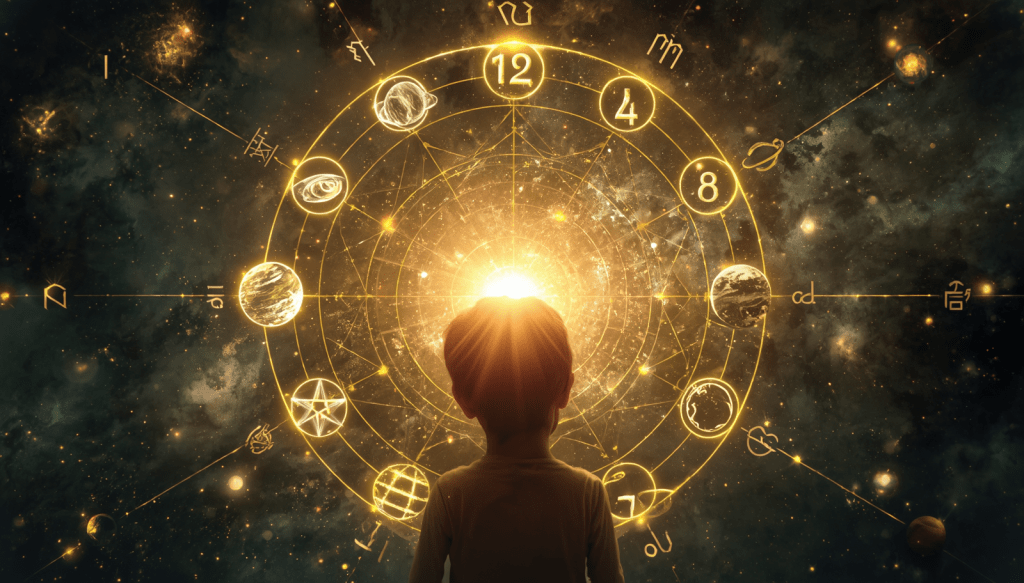
This article offers a close reading of the visionary text “Riddle of the Ark,” in which a paternal divine voice teaches a child “to count to ten” through a sequence of embodied gestures that integrate biblical imagery, cosmology, and contemporary physics. The riddle unfolds numbers one through nine as a “pattern so divine,” mapping them onto directions, religious traditions, chakras, planets, and human gestation, before staging ten as “1–0,” a one standing before an unexplained “hole” or zero that God claims not to have made. Drawing on theological and philosophical discussions of nothingness and creatio ex nihilo, the article argues that the text encodes a theology of zero as a covenantal interval internal to creation: an “unmade” nothing that structures conflict, equilibrium, and divine–human relation. By reading the riddle’s playful references to Max Planck and Lagrange points analogically, the essay situates this doctrine of zero at the intersection of apophatic theology, mathematical cosmology, and embodied ritual pedagogy in religion and science.[2][3][4][5][6][7][8][1]
***
### Keywords
zero; nothingness; creatio ex nihilo; covenant; numerology; apophatic theology; Planck’s constant; Lagrange points; ritual practice; religion and science[3][7][8][9][1][2]
Introduction
“Riddle of the Ark” presents itself as a pedagogical encounter: “My son, what have you learned? Today we shall count to ten. Follow and do as I do.” Through a choreographed series of actions—raising hands, separating them, clasping them in prayer, smashing fists together—the child is invited to learn number not as an abstract sequence but as an embodied script of creation, conflict, and covenant. The divine speaker identifies as “I am that I am,” one who numbers stars and grains of sand, lays out the four directions, positions five religious “pillars” like Lagrange points, births “Atom” on the sixth day, pools seven energies across continents, balances eight planets, and remembers nine months of gestation.[8][10][11][1]
Within this richly patterned count, ten appears only at the end, and its novelty lies not in the “ten” itself but in the zero: “Oh that thing behind the one in the number 10… that hole… the void… the space between then and now. I call it a zero… It’s a mystery to me because I only made 9 numbers.” This paradox—zero present yet disavowed as “made”—invites a theological question at the boundary of religion and science: what kind of “nothing” is zero in this text, and how does this “nothing” relate both to classical Christian accounts of creatio ex nihilo and to scientific treatments of zero, vacuum, and quantum thresholds?[7][1][2][3]
The argument advanced here is that “Riddle of the Ark” implicitly presents zero as a covenantal interval inside creation: an unnumbered ground of number in which conflict is exposed, equilibrium sustained, and divine self-love hiddenly at work. By situating this reading in conversation with apophatic theology, doctrines of creation from nothing, and work on embodiment and ritual meaning, the essay suggests how a seemingly playful numerological riddle can serve as a conceptual bridge between doctrinal and scientific accounts of “nothing.”[4][5][9][12][1]
Embodied numerology as pedagogy
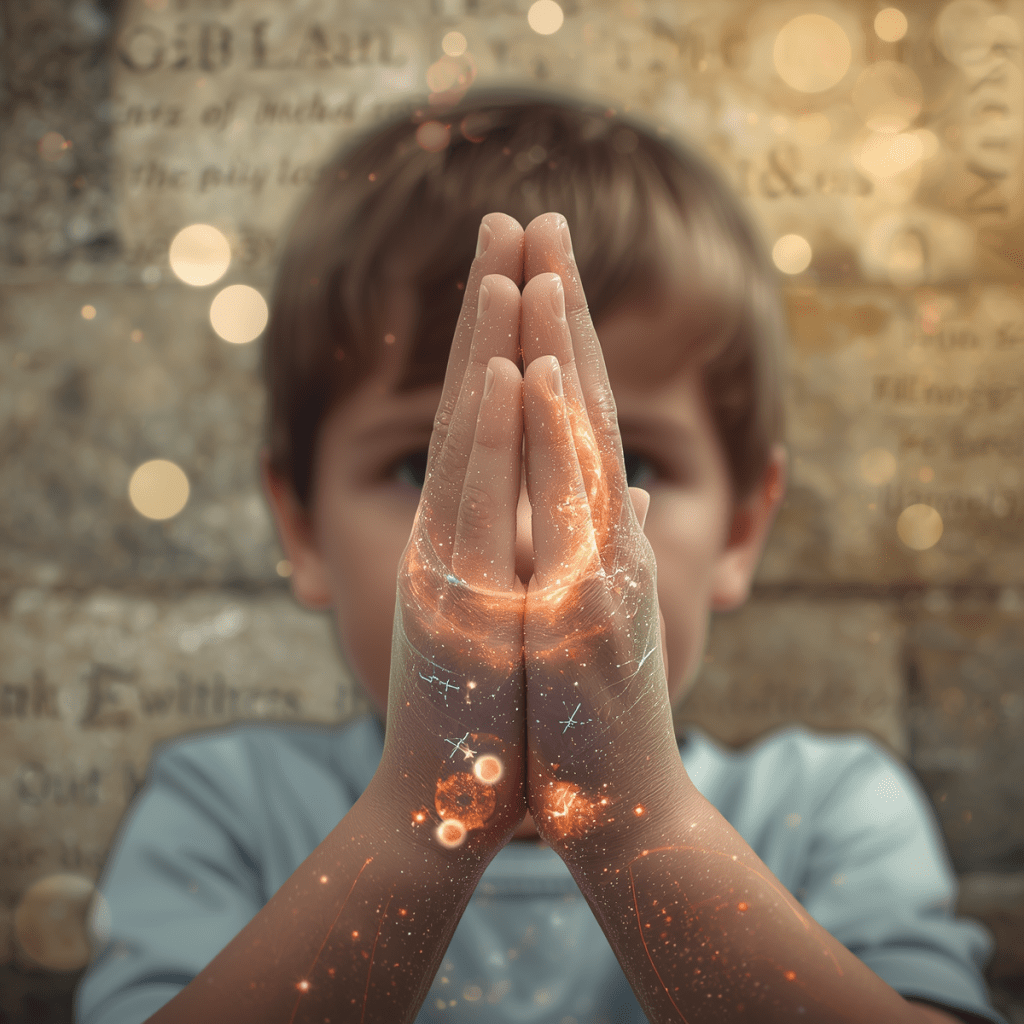
The riddle teaches counting by commanding the body: “Look down towards your hands… Raise your right hand… Raise your left hand… bring them together.” This choreography makes numeracy a ritual act in which motor sequences, sensory awareness, and theological propositions are learned together, aligning with accounts of ritual as a site where bodily performance and verbal meaning mutually generate understanding.[5][1][4]
Scholars of embodied pedagogy in religion note that ritual practices often bind conceptual content to specific bodily postures and movements, such that cognition becomes “simulation” of prior sensorimotor experience. In this light, the repeated refrain “Today we shall count to ten. Follow and do as I do” signals that the child learns not only numbers but also a way of inhabiting the world in which numeration, creation, and covenant are inseparable. Counting thus becomes a liturgical approach to zero, preparing the learner to encounter an unspoken horizon of the sequence.[1][4][5]
Conflict, covenant, and the interval
At a crucial moment, the divine voice instructs the child to stretch both arms wide, clench fists, and, at the word of command—“Hoomakaukau? Pa!”—smash them together “with rage and contempt, determination and assurance.” This impact is immediately interpreted through the children’s song “The ants go marching… the little ant stopped and said, Take this cup from me,” followed by an invitation to “taste the blood of the covenant that drips from your hands” and to “savor the everlasting battle” between good and evil, light and dark, man and woman, peace and war, described as “a feature not a glitch.”[1]
This sequence portrays the “between” of the hands as a site where covenant is cut and conflict revealed as structurally inscribed in human existence. The same hands that harm are later presented as bearing “the foundations of the world” and as instruments of perception and compassion, capable of touching another only when one is “silent to feel their heart.” Theologically, this dramatized interval between opposition and embrace anticipates zero as covenantal space: not mere emptiness, but the charged “void” where relationships are fractured, judged, and potentially reconciled.[1]
The one-to-nine cosmological pattern
The extended anaphora “I am that I am who…” maps numbers one through nine onto a layered cosmology. Four foundations (north, south, east, west) inscribe cardinal space; five LaGrange-like points hold the “five pillars” of heaven’s societies—Buddhism, Hinduism, Judaism, Christianity, and Islam; six marks the day on which God “sneezed and the first man was born,” called “Atom”; seven pools correspond to chakra-like centers across continents; eight celestial planets dance in harmonic octaves; nine months complete gestation in the mother’s womb.[10][11][8][1]
In this pattern, number functions as a unifying code that integrates cosmic structure, religious diversity, psycho-somatic energy, and biological development. The line “From 1 to 9. A pattern so divine. All numbers will bow to the name of number Nine” presents nine as a symbolic fullness or saturation point. Religiously, this resonates with traditions in which nine marks completion before a new cycle, preparing the conceptual and spiritual shock of a zero that is “not made” yet silently conditions the transition to ten.[13][14][1]
Zero as unmade number and theological “nothing”
The text’s climactic twist concerns ten: “Oh that thing behind the one in the number 10. 1-0. That hole. The void. The space between then and now. I call it a zero… It’s a mystery to me because I only made 9 numbers.” Zero is present, named, and visually located “behind the one,” yet simultaneously disowned as a product of divine making; it is both inside and outside the number sequence narrated by God.[1]

Classical Christian doctrine of creatio ex nihilo asserts that God brings all things into being “out of nothing,” where “nothing” is not a something but the radical absence of any preexistent material; creation expresses ongoing dependence, not a change in “nothing” itself. In contrast, “Riddle of the Ark” positions zero as an intra-creational “nothing”: a structured interval between then and now, presence and absence, which God playfully treats as a mystery beyond the nine made numbers. Zero here is neither pre-creational nothingness nor a mere mathematical placeholder; it is the unnumbered ground of number, the internal “nihil” that measures how finite beings live between origin and fulfillment.[6][12][15][2][3][1]
Apophatic theology speaks of God as “beyond being” and sometimes as a “nothingness” that exceeds all concepts, stressing that such “nothingness” marks transcendence rather than lack. The riddle’s zero touches this apophatic register only obliquely: zero is not identified with God but with the space in which creaturely time and relation unfold before God. In this sense, the text stages a distinction overlooked in some popular treatments: the “nothing” of creatio ex nihilo and apophatic divinity, and the “nothing” internal to a created order whose intervals, gaps, and delays still depend on the creator’s sustaining act.[9][16][17][18][2][3][1]
Quantum thresholds and equilibrium metaphors
Early in the riddle, the divine voice invites the child to “feel Max Planck’s scales on the fish you have caught,” naming the fish “Maximus Prime… Karl… In Ernst… a constant Ludwig splashing around… everywhere in the space between all things,” while noting that he is “hard to grasp.” These puns weave together Max Planck, Ernst Mach, Ludwig Boltzmann (and perhaps Ludwig Wittgenstein) into a playful allusion to fundamental constants and the elusive nature of quantum reality. Planck’s constant, in physics, quantizes action and underlies phenomena such as discrete energy levels and uncertainty limits.[19][20][7][1]
Later, the claim “I… plotted the 5 LaGrange points, where I laid the five pillars that hold up the societies of heaven” explicitly invokes Lagrange points as states of gravitational equilibrium in a multi-body system, repurposed here as symbolic locations for world religions. Read analogically, these references do not provide a scientific model of zero but rather suggest that the “space between” is structured like a threshold or equilibrium state: not a featureless void, but a domain where forces and possibilities are balanced or quantized.[11][8][10][1]
From a religion-and-science perspective, zero as covenantal interval can be compared—not equated—with the “nothing” of physical vacua, quantum fields, or boundary conditions in cosmology: apparently empty yet densely structured. The riddle thus treats Planck and Lagrange as metaphoric bridges, inviting readers to imagine theological “nothing” not as dead absence but as a dynamic arena in which God and creation, conflict and harmony, interact under constraints.[20][2][7][8][1]
Zero, self-love, and hidden presence
Near the end, the divine voice declares, “I love you, as I love myself. And, I love myself a whole lot. A hole lot,” turning a pun into a claim about divine self-love and hiddenness. The slippage from “whole” to “hole” intimates that the plenitude of divine love includes, and even passes through, an inner hollow: the zero behind the one, invisible yet structurally necessary.[1]
The repeated assurances “With you I am well pleased… I see you. Can you see me?” position ten as a moment of mutual recognition in which the creature is invited to perceive the unseen behind the seen. Within apophatic frameworks, this corresponds to the idea that God’s most intimate presence often comes as a kind of experienced absence, “nothingness” that exceeds grasp. In the riddle, zero functions devotionally as this hidden dimension: the space where the believer stands between fear and assurance, not yet seeing and yet already seen, held from “one to nine” and beyond.[16][18][9][1]
Conclusion
“Riddle of the Ark” frames counting as a ritualized pedagogy in which the body learns number, creation, and covenant together. Numbers one through nine articulate a dense symbolic pattern—spatial, religious, somatic, planetary, and biographical—culminating in a fullness associated with nine. The emergence of ten as “1–0,” however, shifts attention to zero as a mysterious “hole” that God both names and disavows as made, inviting a theological account of zero as a covenantal interval internal to creation rather than as the absolute nothing of initial creation.[2][3][1]
By placing this reading in dialogue with doctrines of creatio ex nihilo, apophatic discussions of nothingness, and scientific notions of quantified action and equilibrium, the article shows how a contemporary riddle can function as a conceptual bridge in the religion-and-science field. Zero here becomes the unnumbered ground of number: the structured “nothing” in which conflict, equilibrium, and divine self-love are enacted as relations of dependence upon the creator.[12][4][5][6][7][9][2][1]
Future work
Several avenues invite further research. First, historical and systematic work could compare this riddle’s intra-creational “nothing” with patristic and medieval treatments of creatio ex nihilo, nothingness, and apophatic theology, clarifying how a covenantal interval relates to the absolute “nothing” of initial creation. Second, comparative studies might set the riddle’s numerology alongside Jewish, Islamic, Hindu, and Buddhist reflections on emptiness, zero, and ayin/śūnyatā, probing convergences and divergences in how “nothing” is spiritually inhabited.[17][18][21][3][12][13]
Third, drawing on work on embodied pedagogy and ritual meaning, empirical studies in classrooms or congregations could test this counting-ritual as a teaching tool in religion-and-science education, examining how bodily enactment of one to ten affects participants’ understanding of zero, nothingness, and dependence on God. Finally, further constructive theology could explore the implications of zero as covenantal interval for doctrines of providence, human freedom, and eschatological fulfillment, especially where scientific models of openness and indeterminacy are at stake.[14][22][23][4][5][2][1]
References
Apophatic theology. (2002, August 1). In *Wikipedia*. https://en.wikipedia.org/wiki/Apophatic_theology%5B9%5D
“Creatio ex nihilo.” (2005, April 28). In *Wikipedia*. https://en.wikipedia.org/wiki/Creatio_ex_nihilo%5B3%5D
Fox, M. (2022, December 23). *Apophatic divinity: God as nothingness*. Daily Meditations with Matthew Fox. https://dailymeditationswithmatthewfox.org/2022/12/23/apophatic-divinity-god-as-nothingness/%5B16%5D
Harris Wiseman. (2022). Meaning and embodiment in ritual practice. *Zygon: Journal of Religion & Science, 57*(3). https://onlinelibrary.wiley.com/doi/full/10.1111/zygo.12805%5B4%5D%5B5%5D
NASA. (2024, October 31). *What is a Lagrange point?* https://science.nasa.gov/resource/what-is-a-lagrange-point/%5B8%5D
Planck constant. (2001, October 26). In *Wikipedia*. https://en.wikipedia.org/wiki/Planck_constant%5B19%5D
Planck’s constant. (2025, November 14). In *Encyclopedia Britannica*. https://www.britannica.com/science/Plancks-constant%5B20%5D
Riddle of the Ark. (n.d.). Unpublished manuscript/PDF.[1]
Seife, C. (2010). *Zero: The biography of a dangerous idea*. (Summary discussed in Shortform). https://www.shortform.com/summary/zero-summary-charles-seife%5B24%5D
“‘Ex nihilo nihil fit’ and ‘creatio ex nihilo’: Science and creation.” (2023, December 12). *The Josias*. https://thejosias.com/2023/12/13/ex-nihilo-nihil-fit-and-creatio-ex-nihilo-science-and-creation/%5B2%5D
The origin and significance of zero: An interdisciplinary perspective. (n.d.). Described in UCLA Library catalog.[13]
Wiseman, H. (2022). Meaning and embodiment in ritual practice. *Zygon: Journal of Religion & Science*. (PhilPapers abstract.) https://philpapers.org/rec/WISMAE-2%5B25%5D
Zygon Journal. (2022). *Meaning and embodiment in ritual practice* (issue overview). https://www.zygonjournal.org/article/id/14846/%5B4%5D
Sources
[1] Riddle-of-the-Ark.pdf https://ppl-ai-file-upload.s3.amazonaws.com/web/direct-files/attachments/61492393/38edbdff-4d59-4a78-aece-61ce1e07e8b9/Riddle-of-the-Ark.pdf
[2] ‘Ex Nihilo Nihil Fit’ and ‘Creatio Ex Nihilo’: Science and Creation https://thejosias.com/2023/12/13/ex-nihilo-nihil-fit-and-creatio-ex-nihilo-science-and-creation/
[3] Creatio ex nihilo – Wikipedia https://en.wikipedia.org/wiki/Creatio_ex_nihilo
[4] MEANING AND EMBODIMENT IN RITUAL PRACTICE | Zygon https://www.zygonjournal.org/article/id/14846/
[5] MEANING AND EMBODIMENT IN RITUAL PRACTICE – Wiseman https://onlinelibrary.wiley.com/doi/full/10.1111/zygo.12805
[6] Contemplating Nothing | Another Kind of Normal: Ethical Life II https://academic.oup.com/book/38765/chapter/337570664
[7] What is Planck’s constant? – Astronomy Magazine https://www.astronomy.com/science/what-is-plancks-constant/
[8] What is a Lagrange Point? – NASA Science https://science.nasa.gov/resource/what-is-a-lagrange-point/
[9] Apophatic theology – Wikipedia https://en.wikipedia.org/wiki/Apophatic_theology
[10] Lagrange point | Definition & Distance | Britannica https://www.britannica.com/science/Lagrangian-point
[11] Lagrange point – Wikipedia https://en.wikipedia.org/wiki/Lagrange_point
[12] [PDF] Nothingness in Philosophical and Theological Optics – R A I S https://rais.education/wp-content/uploads/2021/07/0071.pdf
[13] The origin and significance of zero : an interdisciplinary perspective … https://search.library.ucla.edu/discovery/fulldisplay?docid=alma9997050598206533&context=L&vid=01UCS_LAL%3AUCLA&lang=en&adaptor=Local+Search+Engine&tab=Articles_books_more_slot&query=sub%2Cexact%2CZero+%28The+number%29%2CAND&mode=advanced&offset=0
[14] Mathematical Theology: Future Science of Confidence in Belief https://www.laetusinpraesens.org/docs10s/maththey.php
[15] [PDF] Creatio Ex Nihilo, Resurrection, and Divine Gratuity https://theologicalstudies.net/wp-content/uploads/2022/11/Robinette-Difference-Nothing-Makes.pdf
[16] Apophatic Divinity: God as Nothingness https://dailymeditationswithmatthewfox.org/2022/12/23/apophatic-divinity-god-as-nothingness/
[17] [PDF] To know nothing. Apophatic theology in the Dionysian corpus https://antiquitasviva.com/wp-content/uploads/2021/07/66.1-2.08.-todorovska-m.-to-know-nothing.-apophatic-theology-in-the-dionysian-corpus.pdf
[18] [PDF] Reflections on the Nothingness of God1 – DVK Journals https://dvkjournals.in/index.php/vs/article/download/3338/3055/7006
[19] Planck constant – Wikipedia https://en.wikipedia.org/wiki/Planck_constant
[20] Planck’s constant | Definition, Units, Symbol, & Facts – Britannica https://www.britannica.com/science/Plancks-constant
[21] Out of Nothing: A History of Creation ex Nihilo in Early Christian … https://scripturecentral.org/archive/periodicals/journal-article/out-nothing-history-creation-ex-nihilo-early-christian-thought
[22] Embodied Pedagogies in Religion https://cswr.hds.harvard.edu/research-programming/transcendence-transformation/research/embodied-pedagogies-religion
[23] Theology and Science, Volume 23, Issue 4 (2025) – Taylor & Francis https://www.tandfonline.com/toc/rtas20/current
[24] Zero Book Summary by Charles Seife – Shortform https://www.shortform.com/summary/zero-summary-charles-seife
[25] Harris Wiseman, Meaning and Embodiment in Ritual Practice https://philpapers.org/rec/WISMAE-2
[26] Saying Nothing about No-Thing – Bahá’í Library Online https://bahai-library.com/winters_apophatic_theology
[27] Apophatic theology and its relationship to contemplation – Facebook https://www.facebook.com/groups/687678892212342/posts/709966656650232/
[28] MEANING AND EMBODIMENT IN RITUAL PRACTICE – Wiseman https://onlinelibrary.wiley.com/doi/abs/10.1111/zygo.12805
[29] Creation Ex Nihilo Through Jesus Christ https://www.icr.org/content/creation-ex-nihilo-through-jesus-christ
[30] Creatio ex Nihilo: Why We Believe – Catholic Stand https://catholicstand.com/creatio-ex-nihilo-why-we-believe/
 The Book of Kalei
Leave a comment